What Do Dodgers Fans Love More: Baseball or Bobbleheads?
by Rikki Bleiweiss
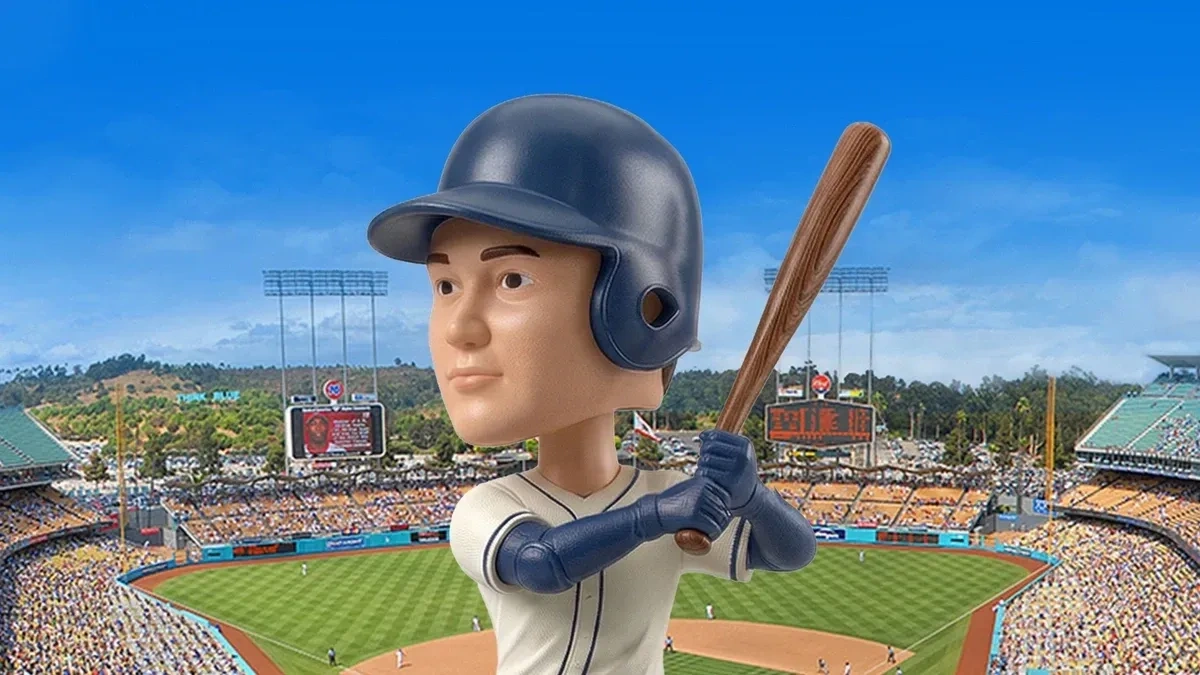
It's a good time to be a Dodgers fan. I'm not even talking about the back-to-back World Series titles, or the three-peat chase that has ESPN declaring the entire 2026 MLB season revolves around Los Angeles. Because the only thing more exciting than a moment like Will Smith's 11th-inning Game 7 walk-off homer (hit two months after he'd broken his throwing hand) is Will Smith's 11th-inning Game 7 walk-off homer commemorated forever in shiny plastic, with a little head that wobbles.
The Dodgers will give away 24 bobbleheads this season — the most any MLB team has ever scheduled in a single year. Our analysis of secondary market transactions across the 2024 and 2025 MLB seasons found that bobblehead giveaway games commanded an average of 22% higher ticket prices than comparable non-promotional games, up from an 11% premium in 2024. That widening gap tells a story about scarcity, star power, and how one franchise is turning a plastic figurine into a serious demand lever.
Get 24 More Bobbleheads and Really Ruin Baseball
The Dodgers' 2026 promotional schedule, announced in February, lists 24 bobblehead dates — with the full calendar running to 33 giveaway events in total. Each bobblehead goes to the first 40,000 fans. No MLB team has come close to this scale before.
The calendar is built around a five-game "Game 7 World Series Commemorative Series" honoring the moments that clinched last year's title: Will Smith's walk-off on March 28, Miguel Rojas's game-tying homer on May 8, Yoshinobu Yamamoto's no-rest relief appearance on May 27, Mookie Betts's double play on June 19, and Max Muncy's home run on August 10. Alongside those, Shohei Ohtani gets three bobbleheads, new signings Roki Sasaki, Edwin Díaz, and Kyle Tucker each get one, and legend Clayton Kershaw gets his farewell figurine. Then there are the celebrity crossovers — Ice Cube, Shaquille O'Neal, LAFC star Son Heung-min — and a Mystery Bobblehead on March 31, because apparently 24 wasn't enough intrigue.
The question is whether any of this actually moves the market. The historical data says yes. In 2024, there were 38 bobblehead events across MLB, and those games saw 39% more tickets sold on the secondary market than non-promotional games, with average prices 11.4% higher. By 2025, teams had taken notice: bobblehead events ballooned to 153 — four times as many — and while the volume lift softened to 10.7% as scarcity eroded, the price premium nearly doubled, growing from 11% to 22%. Research published in the Journal of Sport Management found that stadium giveaways can boost paid attendance by as much as 13%, with bobbleheads consistently outperforming other promotional categories.
That divergence — fewer incremental fans, but those who show up paying significantly more — suggests the bobblehead audience is shifting toward collectors and die-hards who were coming anyway. The Dodgers are betting their roster is deep enough in star power to keep all 24 dates feeling special. Given the data, that's a reasonable bet.
The Ohtani Effect: When Even the Dog Has a Bobblehead
No data point in this analysis is more striking than what happened on August 28, 2024.
That Wednesday, the Dodgers hosted the Baltimore Orioles for a mid-series game with one distinction: it was Shohei Ohtani Bobblehead Night. Compared to the Tuesday and Thursday games in the same series — same opponent, same venue, same week — the bobblehead game sold 129% more tickets on the secondary market and commanded 70% higher average prices, jumping from the $68–$83 range of the surrounding games to $128.52. The only variable was the bobblehead.
Ohtani is, of course, an extreme case. He's arguably the most globally marketable player in baseball, with one leading Japanese travel agency telling CNN it was booking up to 200 clients from Japan for each Dodgers home game — fans who wouldn't otherwise be in the stadium . His bobblehead wasn't just a promotional item — it was a collectible from a once-in-a-generation talent. The phenomenon extended even to his dog: Decoy, a Dutch Kooikerhondje that Ohtani spent three weeks training to sprint from the pitcher's mound to home plate with a baseball in his mouth, earned his own spot on the bobblehead alongside his owner. Fans started lining up at 5 a.m. A gold variant of the giveaway sold for up to $20,000 on eBay. When a free item flips for that kind of money, paying a premium to get through the gate starts to look like a reasonable investment. The Dodgers clearly understood that when they scheduled three Ohtani bobbleheads for 2026.
But the Ohtani data also establishes a ceiling — and a benchmark. Most bobblehead games don't produce that kind of lift, and the Will Smith numbers show why.
How a Bobblehead Announcement Moves Prices in Real Time
The Will Smith bobblehead for the March 28 opener offers a rare window into how sensitive the secondary market is to promotional announcements. When a wave of new ticket inventory hit the market on February 8, prices dropped roughly 45% and the bobblehead game briefly ran 8% below the comparable Friday game in the same series. The following day, the Dodgers officially announced the Will Smith giveaway — and by end of day, the Saturday premium had snapped back to 10%.
Controlling for the typical Saturday-vs-Friday price difference, the true bobblehead-driven premium is estimated at 3–8%. That may look small on paper, but for a game already priced at Opening Weekend levels — one of the highest-demand windows of the season — it represents real money moving on the strength of a plastic figurine.
Which Dodgers Bobblehead Will Reign Supreme?
24 bobbleheads, 24 different bets. The best bobble-team we've had on paper. The Dodgers' 2026 calendar isn't one uniform promotion — it's several different products aimed at different audiences, and the market is likely to treat them differently.
The Game 7 Commemorative Series is nostalgia-driven and tied to a specific emotional peak for Dodgers fans. Those games may sustain strong premiums, particularly for players like Will Smith and Mookie Betts who carry significant cultural weight beyond casual baseball fandom.
The Ohtani bobbleheads — especially the "Greatest Game" dual-pose series — target the broadest possible audience, including international fans and non-traditional attendees who will travel specifically for the collectible. Historical data suggests these will carry the largest demand lift, though whether they can replicate 2024's +129% is unlikely given how anticipated they now are.
The celebrity crossovers (Ice Cube, Shaq, Son Heung-min) are genuinely novel in MLB. There's limited comparable data because no team has run celebrity bobbleheads at this scale. The Dodgers have long leaned into their Los Angeles identity as a cultural institution beyond baseball — their cap alone has become shorthand for Southern California culture across music, film, and fashion , and these crossovers extend that positioning deliberately — Son Heung-min, in particular, likely targets the significant Korean and soccer-following fanbase in LA. These games could draw buyers who have never attended a Dodgers game, or who wouldn't otherwise pay secondary market prices.
The scarcity principle suggests at least some of these 24 games will underperform. When every home weekend has a bobblehead, the urgency of any individual one diminishes. The question for the Dodgers is whether their roster depth — having Ohtani, Freeman, Kershaw, Tucker, and Díaz all in the same season — gives them enough star power to sustain demand across all 24 dates.
No team has ever found out. This season, the Dodgers will.
Everybody Hates Them—Except the 40,000 Fans In Line Since 5AM for Bobbleheads
Albert Pujols said "everybody hates them." With a $400 million payroll, back-to-back titles, and 24 bobbleheads on the schedule, he's probably not wrong. But secondary market data has a way of cutting through the narrative: fans booked flights from Japan to attend bobblehead games, lined up at 5 a.m. for a free figurine that flipped for $20,000 on eBay, and paid a consistent price premium season after season. Whatever you think about how the Dodgers run their operation, the market keeps voting with its wallet.
The real question for 2026 isn't whether bobbleheads move demand — the data is clear that they do. It's whether 24 of them in a single season is genius or overreach. The scarcity effect is real, and the numbers show it eroding as teams flood the calendar with giveaways. But the Dodgers have never run a bobblehead schedule on top of a roster like this one — Ohtani, Freeman, Kershaw, Tucker, Díaz, Snell, Glasnow. If any team can sustain premium demand across 24 dates, it's them.
By September, the data will have its answer. The bobbleheads are already on the shelf.
Methodology: Ticket price and volume data are drawn from secondary market transactions processed on the Gametime platform over the prior two MLB regular seasons, as well as broader secondary marketplace data for league-wide comparisons. Figures represent median and average resale prices across sampled events in the U.S. market and may not reflect face value or other resale platforms. Bobblehead game comparisons control for opponent, venue, and day of week where sample sizes permit. Events with fewer than 100 transactions were excluded from aggregate averages.
Rikki Bleiweiss is Content Lead at Gametime. Read more about our data journalism and editorial standards at gametime.co/blog/about